
Building monitoring guide
Where to place temperature and humidity sensors when investigating damp
A sensor location should answer a building question. A reading in open room air and one beside an affected wall describe different conditions—even when they come from the same type of instrument.
By Trace Metrix · Building investigation and monitoring
The short answer
Separate room conditions from local conditions.
To follow general room conditions, place a temperature and humidity sensor—or thermo-hygrometer—in freely circulating room air, away from direct sunlight and immediate heating, ventilation or moisture sources. Follow the instrument’s own installation instructions.
For an investigation, choose additional locations around the question being examined and label them clearly. A higher relative humidity reading near a cold area may describe a local condition; it is not automatically an error or proof of a moisture source.
Read temperature and relative humidity together. An air sensor beside a wall does not measure the wall’s surface temperature or its material moisture content.
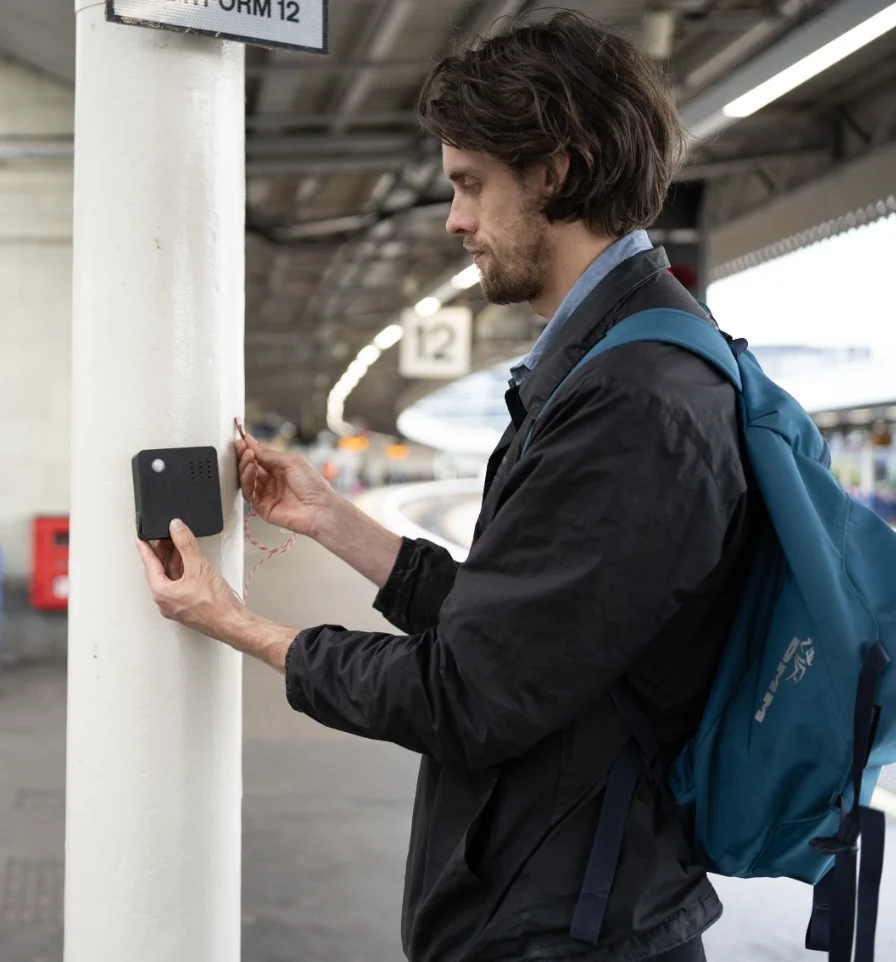
Before leaving a sensor in place
Four placement checks.
- 01
Choose the location for the question
For a room-air reference, choose a position with freely circulating air that is not dominated by a nearby heat or moisture source. If the question concerns a cold corner or an affected wall, a separate, clearly labelled measurement point can help describe conditions there. Do not treat the two locations as interchangeable.
- 02
Check what is close to the sensor
For a room-air reference, avoid direct sunlight, radiators, supply-air jets and the immediate influence of open windows or exterior doors. Direct steam from cooking or a shower describes a particular local event rather than the whole room. These influences may be relevant to an investigation, but record them explicitly if they are part of the measurement question.
- 03
Follow the instrument’s installation guidance
Keep sensing openings clear and follow the manufacturer’s mounting, operating and response-time instructions. After moving a device, allow it to respond as its instructions require before comparing readings. There is no universal mounting height, spacing or waiting time suitable for every instrument and building question.
- 04
Keep positions consistent when comparing periods
Record the device identity, room, position, height and what is nearby, with a photograph or sketch. Note whether the measurement is surrounding air, a surface or a suitable probe access point. If a sensor moves, mark the change in the record: a different position can produce a different pattern without the building itself having changed.
Reading the record
A difference is an observation, not a diagnosis.
Compare readings with inspection findings and notes about heating, ventilation, weather and building use. Check when each device last reported. Before comparing records from different positions, ask whether they describe the same kind of measurement and a suitable period.
Temperature and humidity patterns can help focus the next inspection. They do not, on their own, distinguish a leak from condensation, establish acceptable material dryness or prove that repairs worked. Material questions need an appropriate material measurement method.
Sources and limits
General placement guidance is supported by the instrument guidance below. The building-investigation context reflects the measurement distinctions and monitoring approach described by Trace Metrix. This is not an installation specification or a diagnosis of a particular building; the modular sensor platform remains in development.
Tell us what you need to understand.
Tell us the building question and the locations you need to understand. We can discuss the measurement approach and current availability.
Discuss a monitoring project